Unattended Death Cleanup in Arlington, TX
Professional Unattended Death Cleanup in Arlington, TX — Licensed, Insured & Locally Owned
Trusted Crime Scene Cleanup provides expert crime-scene-cleanup solutions built for Arlington, TX. As a locally owned, licensed team, we deliver quality work tailored to local needs and conditions.
🛡️ Covered by Insurance — $0 Out of Pocket for Most Families
Most homeowners and property insurance policies cover 100% of professional unattended death cleanup. We bill your insurance company directly and manage the entire claim — no upfront cost to you. Call us now: (817) 674-4143
When a loved one passes away and is not discovered for hours, days, or even weeks, the scene left behind poses serious biological and emotional challenges. Trusted Crime Scene Cleanup provides professional, compassionate unattended death cleanup in Arlington, TX, responding 24 hours a day, 7 days a week — including holidays — so families never have to face this alone.
Unattended death cleanup involves the safe removal of human decomposition matter, bodily fluids, odor-causing pathogens, and any secondary contamination that has spread to flooring, subfloor, walls, HVAC ducts, or personal belongings. In Arlington’s climate — where summer temperatures regularly exceed 100 °F — decomposition can accelerate dramatically, making professional remediation not just preferable but essential for health and safety.
Read moreShow less
Our certified biohazard technicians serve Arlington and the greater DFW mid-cities corridor, arriving in unmarked vehicles to protect your family’s privacy. We handle everything from the initial assessment to final clearance testing, and — critically — we work directly with your homeowner’s or property insurance company so the process costs you nothing out of pocket.
Available 24/7 · Discreet Unmarked Vehicles · Insurance Billing Handled for You
Call (817) 674-4143 for an immediate, confidential response.
Understanding Unattended Death Cleanup
An unattended death occurs when a person dies and is not discovered promptly. This can happen for countless reasons: the person lived alone, was estranged from family, or passed away during a holiday weekend when neighbors and visitors were away. The Centers for Disease Control and Prevention (CDC) notes that social isolation is a growing concern across urban and suburban communities in the United States, and unfortunately Arlington — with a population of more than 395,000 — is not immune to this reality.
The moment death occurs, the human body begins a predictable biological process. Within 24–48 hours, bacteria already present in the body accelerate decomposition, producing gases and releasing fluids. By 72 hours, visible decomposition and significant odor are typically present. When ambient temperatures are high — as they routinely are in Arlington from May through September — this timeline compresses sharply. A scene that might remain relatively contained in a cooler climate can become heavily contaminated in just 24–36 hours in North Texas heat.
Read moreShow less
Decomposition fluids are classified as biohazardous waste. They contain pathogens including Hepatitis B, Hepatitis C, HIV, Clostridium difficile (C. diff), and a range of other bacteria and viruses that can survive on porous surfaces — carpet, wood subfloor, drywall, concrete — for extended periods. Standard household cleaning products, bleach solutions, and over-the-counter odor eliminators are wholly inadequate for eliminating these risks.
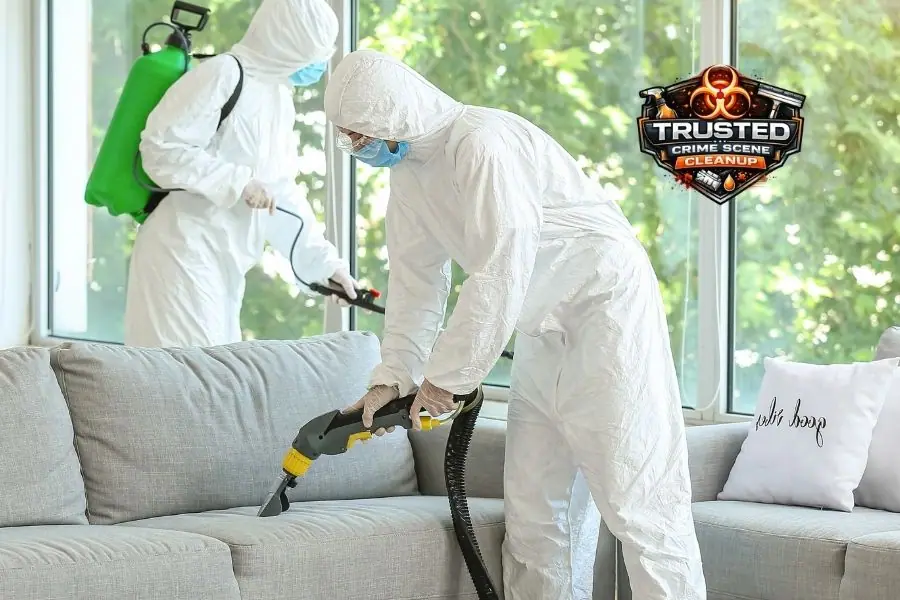
Professional unattended death cleanup technicians are trained under OSHA Bloodborne Pathogen Standards (29 CFR 1910.1030), use EPA-registered hospital-grade disinfectants, and follow strict personal protective equipment (PPE) protocols. The work spans multiple trades: biohazard removal, structural assessment, odor neutralization through hydroxyl or ozone technology, and sometimes controlled demolition of materials too saturated to be remediated in place.
For Arlington property owners — whether the home is a 1960s-era ranch house in Pantego, a newer construction in the Viridian master-planned community, or an apartment in the Entertainment District near Randol Mill Road — the underlying cleanup science is the same, though the structural materials and HVAC configurations vary significantly and shape the remediation approach our team takes.
Why Unattended Death Cleanup Is Critically Needed in Arlington, TX
Climate and Heat Acceleration
Arlington’s climate is classified as humid subtropical (Köppen Cfa), with average high temperatures reaching 96–100 °F in July and August and heat index values that regularly push past 105 °F. The DFW region has recorded stretches of 40+ consecutive days above 100 °F, most notably during the record-setting summer of 2011. In an unventilated interior — a closed home or apartment where air conditioning has been left off — surface temperatures can climb to 120 °F or higher. At these temperatures, decomposition that would take a week in a climate-controlled environment can reach an advanced stage in 48–72 hours, dramatically increasing the volume of biological material that must be remediated.
Housing Stock and Construction Types
Arlington’s residential building inventory spans several distinct eras. Neighborhoods such as Dalworthington Gardens (incorporated 1953) and the older sections of South Arlington near Arkansas Lane feature homes built between the 1950s and 1970s with original hardwood floors, tongue-and-groove subfloors, and pier-and-beam foundations. Decomposition fluids can migrate through these porous assemblies rapidly, reaching the soil beneath the structure in severe cases. Homes in Southeast Arlington’s Meadowbrook area, built primarily in the 1980s, typically have slab-on-grade construction with carpet over concrete — a combination where fluids can wick laterally 18–36 inches beyond the visible stain boundary.
Newer construction in master-planned communities like Viridian (along State Highway 360 near the Trinity River corridor) and Center Place includes engineered hardwood and LVP flooring over OSB subfloors, which absorb fluids differently and require specialized extraction before structural panels delaminate.
Learn moreMulti-Family and Apartment Density
Arlington has one of the highest concentrations of apartment complexes in Tarrant County, particularly along the Collins Street corridor, near the University of Texas at Arlington (UTA) campus, and adjacent to the AT&T Stadium and Globe Life Field entertainment complex. Multi-unit buildings present cross-contamination risks: decomposition odors and fluids can penetrate shared wall cavities, travel through HVAC return air systems, and affect neighboring units — creating liability for property managers beyond just the primary scene.
Aging and Isolated Population
The U.S. Census Bureau’s 2020 data shows that approximately 11.4% of Arlington’s population is 65 or older — representing roughly 45,000 residents. Social isolation among seniors increases the risk that a death will go undetected for multiple days. Additionally, Arlington’s proximity to DFW International Airport (less than 10 miles north) means many residents travel frequently, sometimes leaving elderly family members or neighbors unmonitored for extended periods.
Regional Emergency Response Context
Arlington Fire Department and Arlington Police Department are the first responders to unattended death scenes, but neither agency performs biohazard remediation — nor are they required to. Once law enforcement completes its investigation and releases the scene, the full responsibility for cleanup falls to the property owner or their designated representative. Without a licensed biohazard company, families are left to manage a dangerous, emotionally devastating situation entirely on their own.
Free, no-obligation estimates
Talk to Trusted Crime Scene Cleanup
Tell us what you need and we’ll take it from there.
Signs You Need Professional Unattended Death Cleanup
Visual Indicators
- Dark staining on carpet, hardwood, tile grout, or concrete that does not respond to conventional cleaning
- Visible bodily fluids, tissue, or decomposition matter remaining after emergency responders have departed
- Discoloration of drywall, baseboard, or wall framing near the scene
- Fly activity (blowflies are attracted to decomposition) or visible insect presence inside the structure
- Bubbling, warping, or delamination of flooring materials indicating fluid saturation beneath the surface
Odor Indicators
- A strong, sweet, or putrid odor that persists even after windows are opened and ventilation is increased
- Odor detectable in adjacent rooms, closets, or neighboring units — indicating spread through HVAC or wall cavities
- Odor that intensifies as indoor temperature rises (common in Arlington’s summer months)
Structural and HVAC Red Flags
- HVAC system was running during or after the incident, potentially circulating aerosolized pathogens
- Soft spots in flooring suggesting subfloor saturation
- Pest activity (rodents, insects) that entered the structure during the unattended period
Urgency Indicators — Call Immediately If:
- Law enforcement has just released the scene and cleanup has not begun
- A family member or tenant has entered the scene without proper PPE
- It is summer and indoor temperatures have been uncontrolled for any period
- The scene involves a shared-wall apartment or condo with neighboring units at risk
Our process
Our Unattended Death Cleanup Process in Arlington
- 01
Immediate Response and Scene Assessment (0–2 Hours)
We dispatch a certified technician team to your Arlington location within 60–90 minutes of your call, 24 hours a day. On arrival, we conduct a thorough visual and olfactory assessment of all affected spaces — including adjacent rooms, crawl spaces or pier-and-
- 02
Containment and PPE Setup (1–2 Hours)
We establish negative-pressure containment using 6-mil polyethylene sheeting and commercial HEPA-filtered air scrubbers to prevent cross-contamination. In Arlington apartment complexes, this step is especially critical — we seal HVAC vents and doorways to prot
- 03
Biohazard Removal and Material Disposal (2–8 Hours)
All biohazardous materials — including saturated carpet, padding, subfloor sections, drywall, and personal property that cannot be safely decontaminated — are removed, double-bagged in red biohazard-rated waste bags, and transported in sealed, permitted dispos
- 04
Disinfection and Sanitization (2–4 Hours)
We apply EPA-registered, hospital-grade disinfectants with verified kill claims against Hepatitis B, Hepatitis C, HIV, and C. diff to all affected surfaces — including structural cavities exposed during removal. A dwell-time protocol ensures pathogen eliminati
- 05
Odor Neutralization (1–24 Hours, Depending on Severity)
We deploy hydroxyl generators and/or thermal fogging to neutralize odor-causing molecules at a molecular level — not simply mask them with fragrance. For severe decomposition in sealed rooms, ozone treatment may be utilized after occupants and pets have vacate
- 06
Post-Remediation Testing and Clearance (1–2 Hours)
We conduct ATP (adenosine triphosphate) surface testing and visual inspection to verify that contamination has been eliminated to safe levels. Documentation is provided for your records, your insurance company, and any future property disclosure requirements.
- 07
Insurance Claim Submission and Follow-Up
We submit all documentation, photographs, and invoicing directly to your insurance carrier and follow up on the claim on your behalf. You do not pay us — your insurance company does.
Cleanup Methods and Specialized Approaches
1. Controlled Demolition and Structural Remediation
When decomposition fluids have migrated into subfloor assemblies, wall cavities, or pier-and-beam voids — common in Arlington’s pre-1980 housing stock — surface cleaning alone is insufficient. We perform controlled demolition: removing and disposing of saturated materials to expose and treat the underlying structure. This approach is used in older neighborhoods like Meadowbrook and South Arlington when fluid penetration depth exceeds the top layer of flooring.
2. HVAC Decontamination
In any scene where the heating and cooling system was operational during or after the unattended period, aerosolized biological particles may have entered the ductwork. Our HVAC decontamination service includes duct inspection, fogging with EPA-registered disinfectants, filter replacement, and — where necessary — interior duct cleaning to prevent ongoing odor and pathogen circulation. This is especially relevant in Arlington apartment complexes with shared air-handling units.
3. Hydroxyl and Ozone Odor Treatment
Hydroxyl generators are safe to operate in occupied or partially occupied structures and are our preferred first-line odor neutralization tool. For extreme decomposition odor embedded in porous building materials — a frequent challenge given Arlington’s high summer temperatures — we escalate to ozone shock treatment, which requires temporary evacuation but achieves molecular-level odor elimination.
4. Trauma and Secondary Contamination Cleaning
Personal property, furniture, and belongings that were present during the unattended period are assessed individually. Items that can be safely decontaminated are treated using enzyme-based cleaners and disinfectants; items that cannot are documented and disposed of per TCEQ biohazardous waste regulations.
5. Infectious Disease Decontamination Protocol
Where communicable disease is a known or suspected factor, we implement our full infectious disease decontamination protocol, including enhanced PPE, additional containment measures, and confirmation testing.
Insurance Coverage and Cost Information
How Insurance Coverage Works
Most standard homeowners insurance policies (HO-3 and HO-5 form policies common in Texas) include coverage for biohazard remediation following a death on the property. Renter’s insurance and landlord property policies frequently include similar provisions. We recommend calling your insurance provider immediately after emergency responders clear the scene; our team can also assist you in initiating the claim during our initial response call.
Coverage typically applies to: professional labor, EPA-registered disinfectants and deodorization, biohazardous waste disposal fees (required by TCEQ), structural repairs necessitated by contamination (subfloor, drywall), and HVAC decontamination. Most policies cover the full cost with no out-of-pocket expense to the policyholder beyond any existing deductible. We can advise you on how to minimize or eliminate deductible exposure based on your specific policy language.
Typical Cost Ranges (Without Insurance)
For clients without applicable insurance coverage, or for reference purposes:
- Standard single-room cleanup (early-stage decomposition): $1,500–$3,500
- Multi-room or advanced decomposition: $3,500–$8,000
- Severe decomposition with structural remediation (subfloor, wall cavity removal): $8,000–$20,000+
- Apartment or multi-unit with HVAC decontamination: $4,000–$12,000+
Pricing varies based on square footage affected, severity and duration of decomposition, structural material types (pier-and-beam vs. slab, hardwood vs. carpet), and HVAC complexity. Arlington’s summer heat can increase the affected area and thus the remediation scope significantly compared to equivalent situations in cooler climates.
Call (817) 674-4143 for a free, no-obligation assessment and insurance verification.
Arlington Neighborhoods We Serve
Dalworthington Gardens
This small, incorporated city within Arlington’s boundaries features predominantly mid-century homes (1940s–1960s) on pier-and-beam foundations with original wood subfloors. These structures require careful below-foundation inspection during decomposition cleanup, as fluids can migrate into the crawl space and soil beneath.
Meadowbrook / Southeast Arlington
Primarily developed in the 1970s and 1980s, Meadowbrook homes feature slab construction with wall-to-wall carpet — materials that absorb decomposition fluids laterally and deeply. Many properties also have original single-pane windows that limit ventilation and accelerate indoor temperature buildup during summer.
Pantego
This enclave community (76013 ZIP code) is surrounded by Arlington and features a mix of 1960s ranch homes and small apartment complexes. Its older housing stock, combined with high summer temperatures, makes rapid professional response especially important here.
Entertainment District / Collins Street Corridor
The high density of apartment complexes near AT&T Stadium, Globe Life Field, and the University of Texas at Arlington campus means unattended deaths in this area frequently affect multi-unit buildings. We respond with apartment-specific containment protocols to protect neighboring tenants and limit management liability.
Viridian and East Arlington (Near SH-360)
Newer construction (2010s–2020s) in this master-planned community features engineered hardwood and LVP flooring over OSB subfloors. While visually modern, these materials are particularly susceptible to rapid delamination when exposed to decomposition fluids, requiring prompt response to limit structural damage and remediation cost.
We also serve all surrounding cities including Fort Worth, Grand Prairie, Irving, Mansfield, Hurst, Euless, Bedford, Kennedale, Cedar Hill, Duncanville, Forest Hill, Haltom City, Richland Hills, North Richland Hills, and more.
Preparedness Tips for Arlington Property Owners and Families
While no one can fully prevent an unattended death from occurring, the following steps can reduce risks and ensure faster discovery and response when it matters most:
- Wellness check agreements: Establish a mutual check-in schedule with elderly neighbors or family members — a simple daily text or call can trigger faster discovery and dramatically reduce decomposition severity in Arlington’s summer heat.
- Smart home sensors: Motion sensors or smart doorbell cameras with activity monitoring can alert designated contacts if no movement is detected for 24+ hours.
- Emergency contact cards: Keep a visible emergency contact list in the home and with a trusted neighbor — Arlington Police and Fire can perform welfare checks when contacted.
- HVAC maintenance: A properly functioning HVAC system maintains stable indoor temperatures. A failed AC unit in Arlington summer creates conditions for extremely rapid decomposition.
- Review your insurance policy annually: Confirm that your homeowner’s or renter’s policy includes biohazard cleanup coverage. Note your deductible amount. Keep your policy number accessible for emergency situations.
- Save our number now: Store (817) 674-4143 in your phone. In the aftermath of a traumatic discovery, having a trusted professional’s contact readily available reduces decision-making burden during an already overwhelming moment.
- Do not attempt DIY cleanup: Without proper PPE, OSHA-compliant procedures, and EPA-registered products, attempting to clean a decomposition scene exposes you to serious pathogen risk and may void your insurance coverage.
Why Choose Trusted Crime Scene Cleanup in Arlington, TX
When Arlington families and property managers face the aftermath of an unattended death, they need a team that combines technical expertise, genuine compassion, and seamless insurance handling. Here is why Trusted Crime Scene Cleanup is the right call:
Insurance-First Approach:
Insurance-First Approach:We lead every engagement by verifying your coverage and initiating the claim process — most clients pay $0 out of pocket. We bill insurance directly and handle all claim documentation.
24/7 Local Response:
24/7 Local Response:We serve Arlington and the entire DFW mid-cities area around the clock. Our 60–90 minute average response time reflects our local presence.
OSHA-Trained, TCEQ-Compliant Technicians:
OSHA-Trained, TCEQ-Compliant Technicians:Every technician is trained in OSHA Bloodborne Pathogen Standards and our disposal is fully compliant with Texas Commission on Environmental Quality regulations.
Discreet, Unmarked Vehicles:
Discreet, Unmarked Vehicles:We protect your family’s privacy and respect your neighbors. No logos on vehicles, no unnecessary attention drawn to the property.
Compassionate, Judgment-Free Service:
Compassionate, Judgment-Free Service:Our team understands that every call represents a family in crisis. We treat every client and every property with respect.
FAQ
Frequently Asked Questions — Unattended Death Cleanup in Arlington, TX
Does homeowner’s insurance really cover unattended death cleanup in Texas?
In most cases, yes. Standard HO-3 and HO-5 homeowner’s insurance policies commonly include coverage for biohazard remediation following a death on the property, treating it similarly to water or fire damage. Texas does not prohibit this coverage, and many policies include it without the policyholder being aware. We verify your coverage during our initial call at no cost and manage the entire claim on your behalf. Most Arlington clients pay $0 out of pocket.
How quickly do you respond in Arlington?
Our average response time to Arlington addresses is 60–90 minutes from your initial call, 24 hours a day, 7 days a week. Given Arlington’s summer temperatures, we treat every call as time-sensitive — heat dramatically accelerates decomposition and increases the scope of remediation needed if response is delayed.
How long does unattended death cleanup take?
Most single-room scenes are remediated within 4–8 hours of our arrival. Multi-room scenes, or cases involving structural remediation (subfloor removal, wall cavity treatment) or HVAC decontamination, may require 1–2 days. Severe decomposition in older Arlington homes with pier-and-beam foundations may require an additional site visit for below-structure inspection and treatment.
Will my neighbors or building manager know what happened?
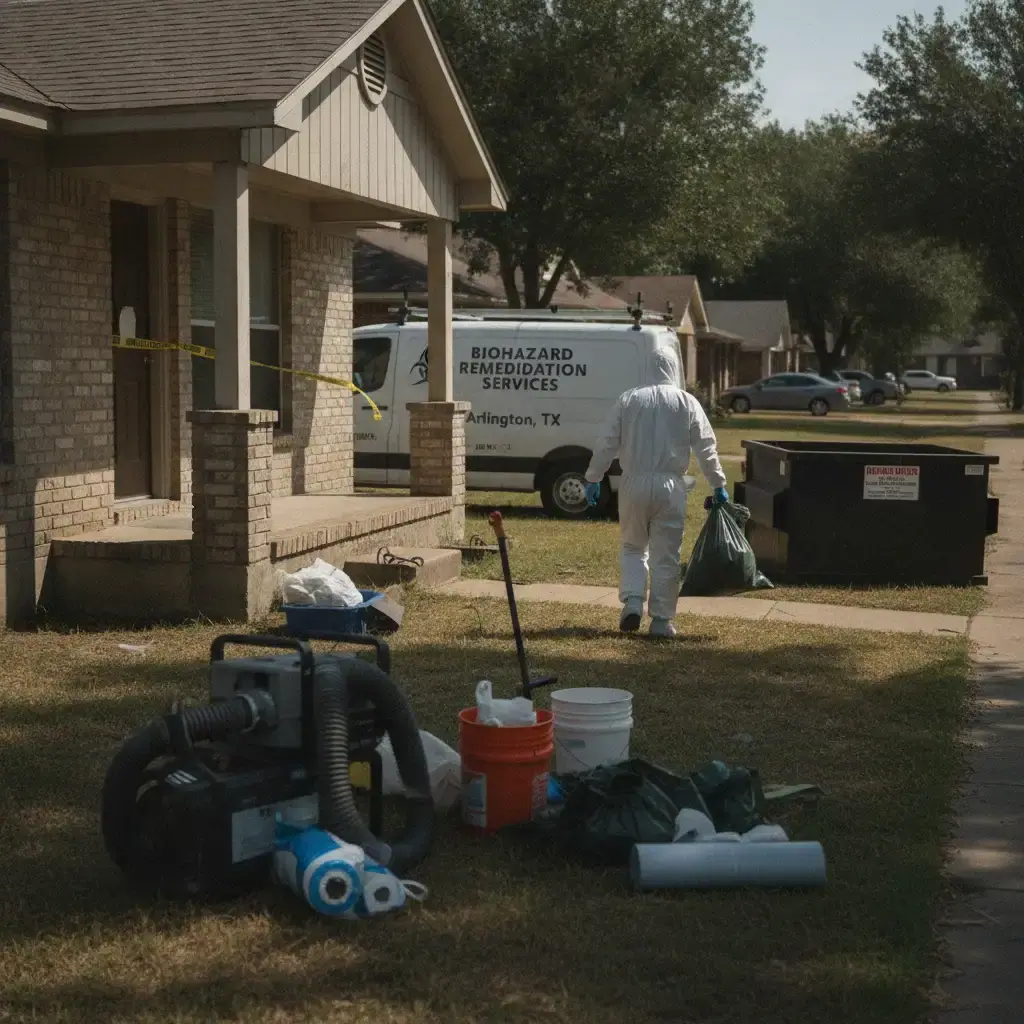
We take discretion extremely seriously. Our vehicles are unmarked, our technicians wear civilian clothing over their PPE and suit up on-site, and we work efficiently to minimize the time visible equipment is staged outside your property. We do not discuss any details of a job with anyone other than the client or their designated representative and insurance company.
What if the scene is in an apartment — can you handle shared-wall situations?
Absolutely. Apartment and multi-unit scenarios are among the most complex we handle. We establish negative-pressure containment before any disturbance of materials, seal HVAC vents, and assess neighboring units for secondary contamination. We communicate directly with property management as needed and document our work to protect both the property manager and tenants from ongoing liability.
Can I enter the scene before you arrive to retrieve personal items?
We strongly advise against it. Decomposition scenes contain aerosolized pathogens, surfaces contaminated with bloodborne pathogens, and potentially compromised structural elements. Without proper PPE and training, entering the scene exposes you to serious health risks. Additionally, disturbing the scene before insurance documentation is complete could complicate your claim. Wait for our team — we will work with you to prioritize and safely retrieve important personal items as part of our process.
What happens to contaminated belongings and furniture?
Each item is assessed individually. Items that can be safely and thoroughly decontaminated are treated and returned. Items that cannot — such as heavily saturated mattresses, upholstered furniture, or saturated carpet — are documented with photographs, listed in our insurance claim submission, and disposed of in accordance with TCEQ biohazardous waste regulations. In many cases, the cost of replacing these items is covered by your insurance claim.
Do you serve areas outside Arlington proper?
Yes. In addition to all Arlington neighborhoods, we serve Fort Worth, Grand Prairie, Irving, Mansfield, Hurst, Euless
Get in touch
Find crime scene cleanup help near you
Request a free estimate online or give us a call — our team will follow up quickly.
- Call us+1 (945) 941 21-70
- Hours24h